|
The Wimberley Valley Watershed Association, in cooperation with the
U. S. Geological Survey, the University of Texas at Austin, the Edwards Aquifer Authority and the Hays Trinity Groundwater Conservation District will be performing a series of tracer tests over the next few weeks to help define groundwater flow paths and velocities in the Jacobs Well, Cypress Creek watershed in northwestern Wimberley.
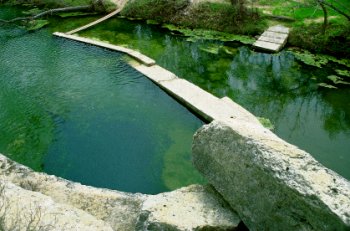
Jacobs Well is one of the largest springs that discharge from the Lower Glen Rose Limestone and is part of the Trinity Aquifer system. Jacobs Well appears to be formed along a series of fractures associated with a large fault along Cypress Creek. The tracer tests will be used to help determine the areas that recharge Jacobs Well, the relationship of groundwater flow to faults and fractures, and how quickly groundwater flows in the area.
Harmless tracing agents, approved by the US Food and Drug Administration and commonly used in the food, cosmetic, and medical fields, will be injected into a series of caves and sinkholes. Jacobs Well, along with private and public drinking water wells, will be monitored for the presence of the dye. The tracer tests are designed so that it is very unlikely that the tracing agents will be directly visible in either the spring or water wells.
Students from the Jackson School of Geological Sciences will be collecting samples and analyzing them for the presence of dye on the Edwards Aquifer Authority's luminescence spectrometer, an instrument designed specially to detect very low concentrations of dye. Springs and wells in the area will be monitored for up to three weeks. A work plan detailing the tracer test methods has been prepared for the study.
RELATED LINKS:
» Wimberley
Valley Watershed Association
» The
Fatal Allure of Jacob's Well » Wimberley
Rivers and Creeks
»
U. S. Geological Survey »
University of Texas at Austin »
Hays Trinity Groundwater Conservation District |