|
|

|
|
« Return to Critters
|
|
|
|
 Email this Email this
 Discuss
this Discuss
this
|
|
|
HILL COUNTRY HOME GUIDE
 |
|
FEATURED
PROPERTY
BUILDING
Architects,
Design
Homebuilders
Construction
Manufactured
Homes
BUYING
Agents
& Brokers
Developments
Inspection
Services
Mortgage &
Title
Property Insurance
Surveying
Services
EXTERIOR
SERVICES
Concrete
Decks, Gazebos
Driveways, Roads
Fences,
Gates
Landscaping, Trees
Pools,
Fountains
Roofing
Stonework,
Masonry
INTERIOR
SERVICES
Finish
Work
Floors
Furnishings
& Decor
Interior
Design
Painting,
Drywall
Tile
& Tilework
MORE
SERVICES
Cleaning,
Disposal
Equipment,
Rental
Moving,
Storage
Pest
Control
Repairs,
Maintenance
Security Services
Supplies and Materials
UTILITIES
AC,
Heating
Communications
Electrical,
Gas, Solar
Plumbing
Rainwater
Collection
Water, Wells & Septic
Get
on the Guide
|
 |
|
|
| The Texas Longhorn, Part 1 - A Three-Part Series by Lewis Smith
Photographs and Article by Lewis Smith
The
Texas Longhorn made more history than any other breed of cattle the
civilized world has known. He was the peer of bison or grizzly bear...
he will remain the bedrock on which the history of the cow country of
America is founded. [J. Frank Dobie, The Longhorn]
Much as it’s appreciated, you don’t necessarily have to refer to the work of a great Texas historian such as Frank Dobie to understand there’s something very special about Longhorns. That’s especially true in this state where “The Longhorns” and mascot Longhorn steer “Bevo” are synonymous with the University of Texas... and where the Yellow Pages are full of every sort of “Longhorn” business from auto dealers and exterminators to hotels and saloons.
Beyond their attention-grabbing looks there’s much more that makes the Longhorn truly special and an increasingly popular feature of the Wimberley countryside.
The Ultimate Survivalist
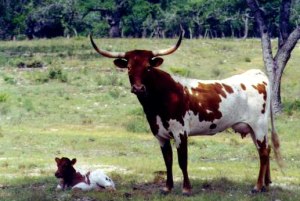
| A brand-new Lord Nelson with proud mom, Lena Belle
|
|
It’s a breed which has survived and evolved from every extreme nature can cook up. First, they had to survive the harshness of long voyages to the new world from Spain nearly 500 years ago, and then the rigors of life in the wilds of Mexico and the Southwest. It’s the only cattle breed in America which, without aid from man, is truly adapted to America. They not only survived, they flourished. Why?
Here are just a few of the breed’s unique characteristics:
* Highly disease resistant
* Longevity - European breeds - Simmental, Limousin, etc. - peak out at around 9-10 years of age; British breeds, an average of 12 years and Brahman-influenced cows a little longer, to 15; but Longhorns commonly produce into their late teens and 20s
* Ease of calving - deliver close to 100% without assistance year after year, unlike virtually every other breed, unless crossed with a Longhorn at some time
* Terrific mothers - reliably producing milk and no-nonsense protection for their young
* Colorful! In addition to spectacular horns, many breeders and fans feel this is the most important attribute. Any and every color combination is the norm, and you never know what color a calf is going to be. Also, colors often change as the calf ages; from light red to brown, to black, for example.
* Gentility. It’s a breed standard. To be a passable Longhorn, it’s got to have a “mild, tractable” disposition (with people, not predators).
In short, the process of evolution -- “survival of the fittest” -- has produced an animal with a body structure equal to its environment, along with uncommon hardiness, horns, senses and wit.
Impact on Texas
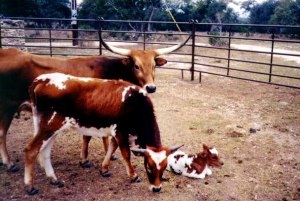
| Mother, Rosebud (4 years old), with daughters
|
|
In the 1800s, the Longhorn was critical to the economy of the State. Exports by trail drive to Northern markets grew from a relative trickle before the Civil War, to a post-War flood, responsible for Texas’ economic recovery. It’s estimated that more than 10 million Longhorns flowed North from their Texas origins from the end of the War until a combination of barbed-wire fenced property and rapidly developing civilization choked down the trails.
|
|


